
Møn with Children
Hunting fossils, exploring the GeoCenter, swimming at shallow beaches and stargazing - Møn is a rewarding destination for a family holiday.
Contents
Møn is a rewarding destination for a family holiday: distances are short, the countryside is easy to explore on foot or by bike, and the GeoCenter provides an indoor attraction that works even on a rainy day. Once you've made the international trip to Denmark and crossed the bridge from Copenhagen, around an hour's drive, the island itself is compact and easy to get around, which makes it practical even for a shorter family stay.
Fossil hunting below the cliffs
The beach below Møns Klint is a genuine adventure for children: scattered in the shingle beneath chalk cliffs up to 128 metres high lie fossils from the Cretaceous sea that covered this area some 70 million years ago. With a little patience, you can find fossilised sea urchins, belemnites (nicknamed "thunderbolts"), and remains of giant clams, oysters and sponges.
One thing to know beforehand: tools such as picks are not allowed, you may only collect what's visible on the beach. Finds can be kept; only extremely rare pieces (so-called Danekræ, such as a mosasaur tooth) must be handed in to a museum. The GeoCenter Møns Klint runs guided fossil-hunting tours daily during the main season and school holidays, usually at 11:00 and 14:00 and lasting about an hour. They cost an extra 25 DKK per person on top of admission and run in Danish and English, sometimes German too, with expert guidance, children tend to find far more.
The path down to the beach runs via long staircases. The longest, the Maglevandstrappen, has 497 steps and is reckoned the longest staircase in Denmark, though several shorter descents are also available. With small children, it's worth choosing a shorter descent and allowing plenty of time for the climb back up. Up on the cliff edge, the rule is always to keep well back, since rockfalls do happen. The cliff-fall status changes from time to time, it's worth checking current local warnings before your visit.
The GeoCenter, a rainy-day plan
Above the cliffs, GeoCenter Møns Klint uses interactive stations, models and films to explain how the chalk cliffs formed, from dinosaurs to a fossil workshop. That makes it a reliable bad-weather option and a destination that holds attention for several hours, across all ages.
A few practical details:
- Season: The GeoCenter is open seasonally, roughly from Easter to the end of October; it's closed from late October to mid-March.
- Opening hours: Usually 10:00 to 18:00 during the high season from late June to early August, and mostly 11:00 to 17:00 in the shoulder season. Hours vary, so it's best to check in advance.
- 2026 prices: Day ticket 155 DKK (adults) and 100 DKK (children 3-11), under 3s free. Booking online saves 10 DKK per ticket; parking costs 45 DKK.
- Longer stays: For repeat visits there's a weekly pass (200/145 DKK) and a season pass (250/195 DKK); groups of 10 or more pay 135/85 DKK.
Swimming at shallow, child-friendly beaches
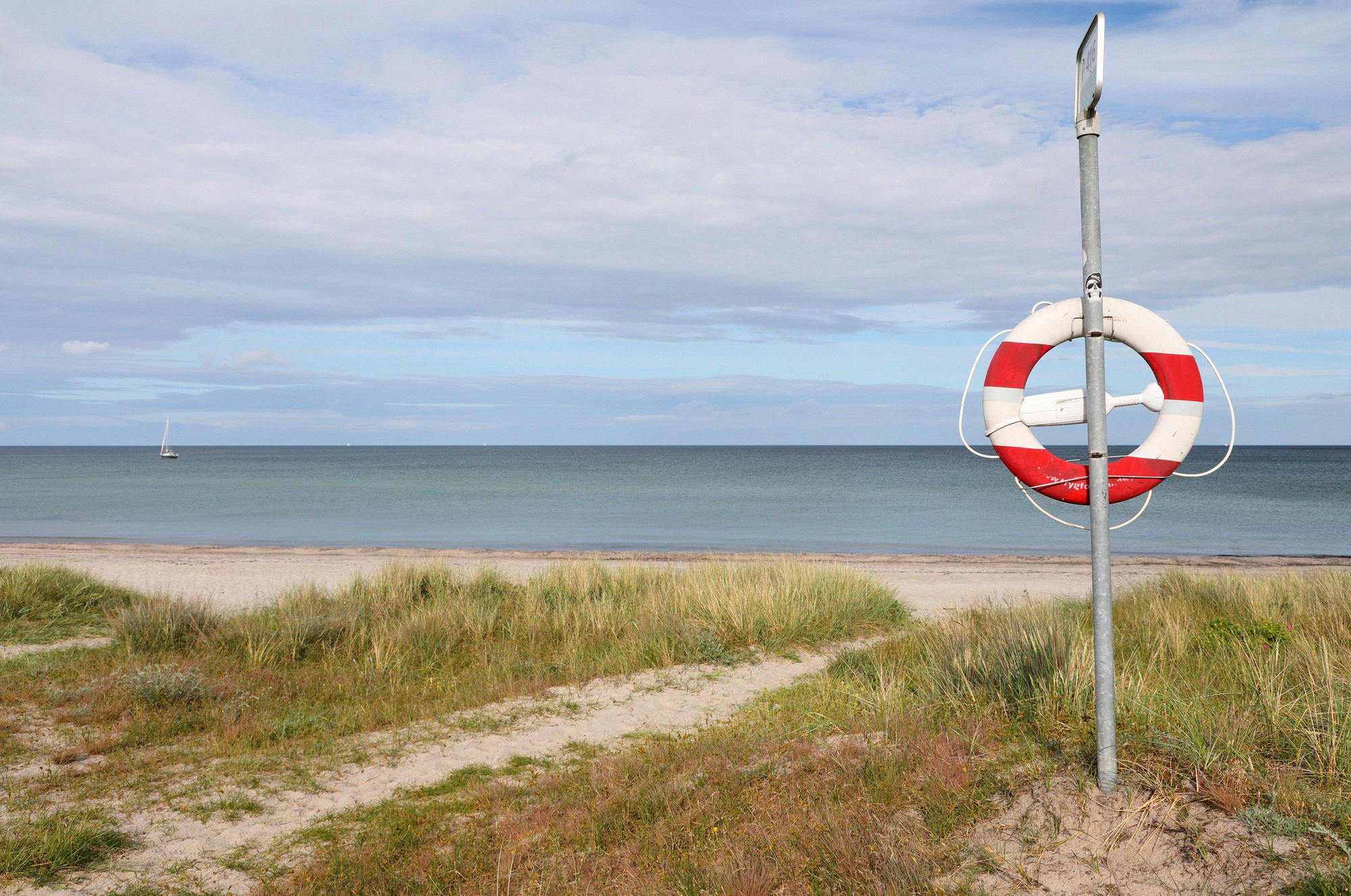
The rugged east coast around the cliffs isn't well suited to swimming with small children. Instead, head to the flat, sandy beaches in the north and along the south coast:
- Ulvshale: This beach in the north is flat and family-friendly, with free parking. There are proper toilet facilities, including an accessible toilet, plus first-aid and lifesaving equipment.
- Klintholm Havn: Parking sits right behind the beach, with two sandy stretches, public toilets and showers at the marina, and several restaurants, a supermarket and a fishmonger nearby, handy for a full day at the beach.
Several beaches on Møn, including Ulvshale and Råbylille, carry Blue Flag status, which certifies water quality. The Baltic warms up pleasantly here in high summer but stays cooler than the Mediterranean, a wetsuit, or a beach day built around digging rather than long swims, often works better with children.
Birdwatching on Nyord
Just north of Møn lies the small island of Nyord, with its broad coastal meadows, at roughly 400 hectares, one of the largest meadow areas in eastern Denmark and a haven for birds. Three birdwatching towers stand along the east side, signposted from the ring road and freely accessible; the second tower is covered and wheelchair-accessible.
For children, the sheer numbers are the main draw: in autumn and winter, swans, geese, ducks and wading birds gather here in huge numbers, barnacle geese in flocks of 5,000 to 7,000 birds. In spring and autumn, enormous flocks of finches pass through; days with 30,000 to 50,000 birds are not unusual. A pair of binoculars is essential kit.
Stargazing in the Dark Sky Park
Møn and Nyord were named Scandinavia's first Dark Sky Park and, at the same time, its first Dark Sky Community in 2017, the first place in the world to hold both designations at once, and with the highest Gold-tier status. In practice, that means almost no light pollution and a genuinely dark night sky. On a clear night, more than 5,000 stars are visible above the island with the naked eye, and the Milky Way and shooting stars become a real spectacle.
It works best on dark, moonless nights in autumn and winter, when darkness falls early, so children don't need to stay up late into the night. For more background, see the feature on the Dark Sky Park Møn & Nyord.
Practical tips for a family trip
- Passage graves as an adventure: Kong Asgers Høj near Sprove is Møn's largest passage grave, the chamber runs about 10 metres long, the passage around 7.5 metres, and you can walk in almost upright. The grave is freely accessible but pitch dark inside. A torch is essential; for slightly older children, a visit is a small highlight.
- Getting around by bike: Distances on the island are short and many roads are quiet, making a cycling trip enjoyable for families too. For those who'd rather walk, the guide to hiking on Møn has suitable routes.
- Where to stay: Holiday cottages and campsites suit families well; several sites around the cliffs and near Ulvshale also rent cabins. See the guide to accommodation on Møn for an overview.
- Rainy-day options: Besides the GeoCenter, regional museums, mini-golf and indoor/outdoor pools at campsites make good alternatives.
- Getting there and timing: The bridge makes Møn quick to reach once you're in Denmark, see the guide to getting to Møn for details. For which season suits families best, see the guide to the best time to visit: a weekend covers the highlights, a week allows for more relaxed exploring.
