
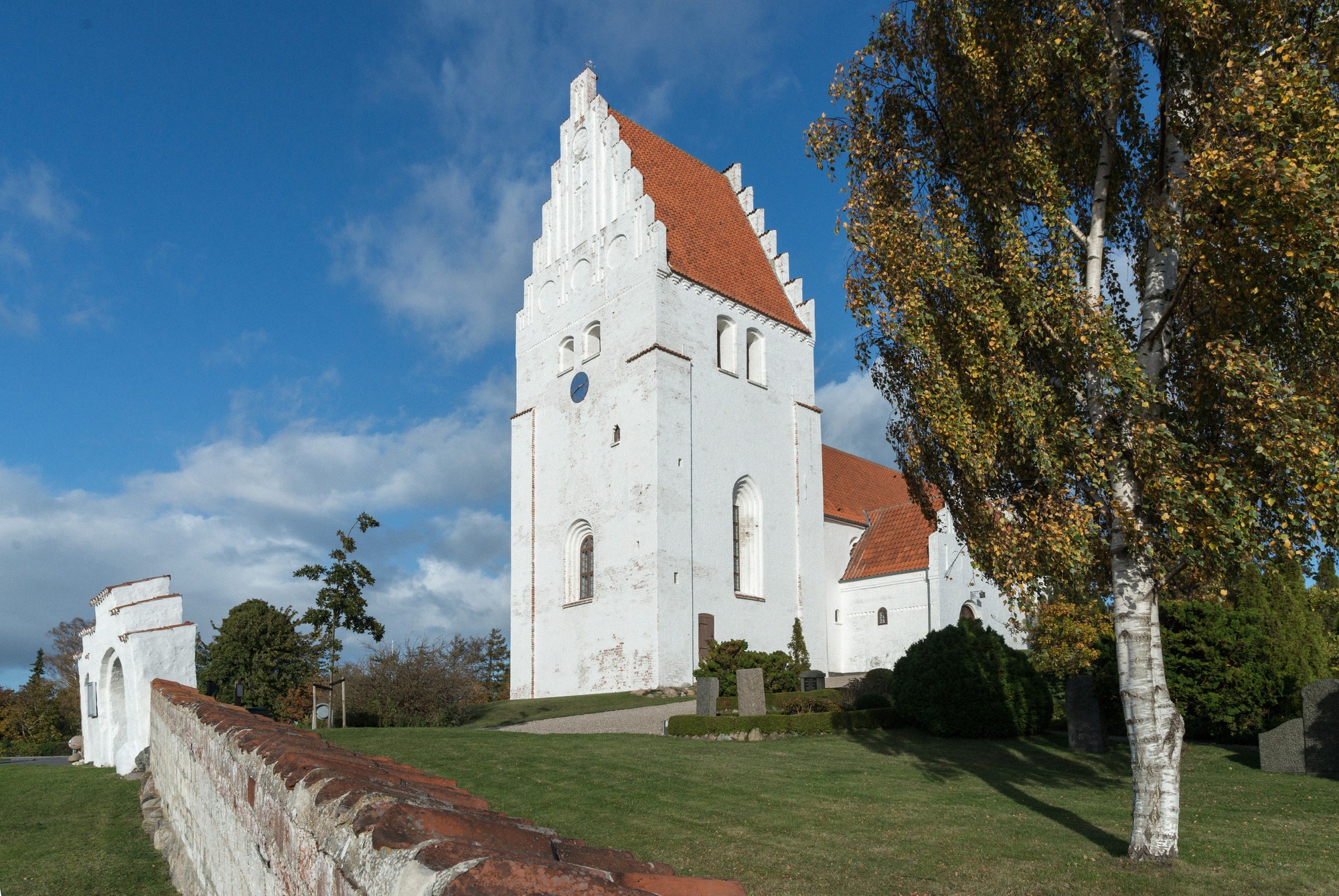
Elmelunde Kirke
Medieval fresco church of the Elmelunde Master
Overview
Møn has three famous fresco churches - Elmelunde, Keldby and Fanefjord. Their vaults carry the medieval wall paintings of the Elmelunde Master, painted around 1500, all free to visit.
Medieval fresco church of the Elmelunde Master
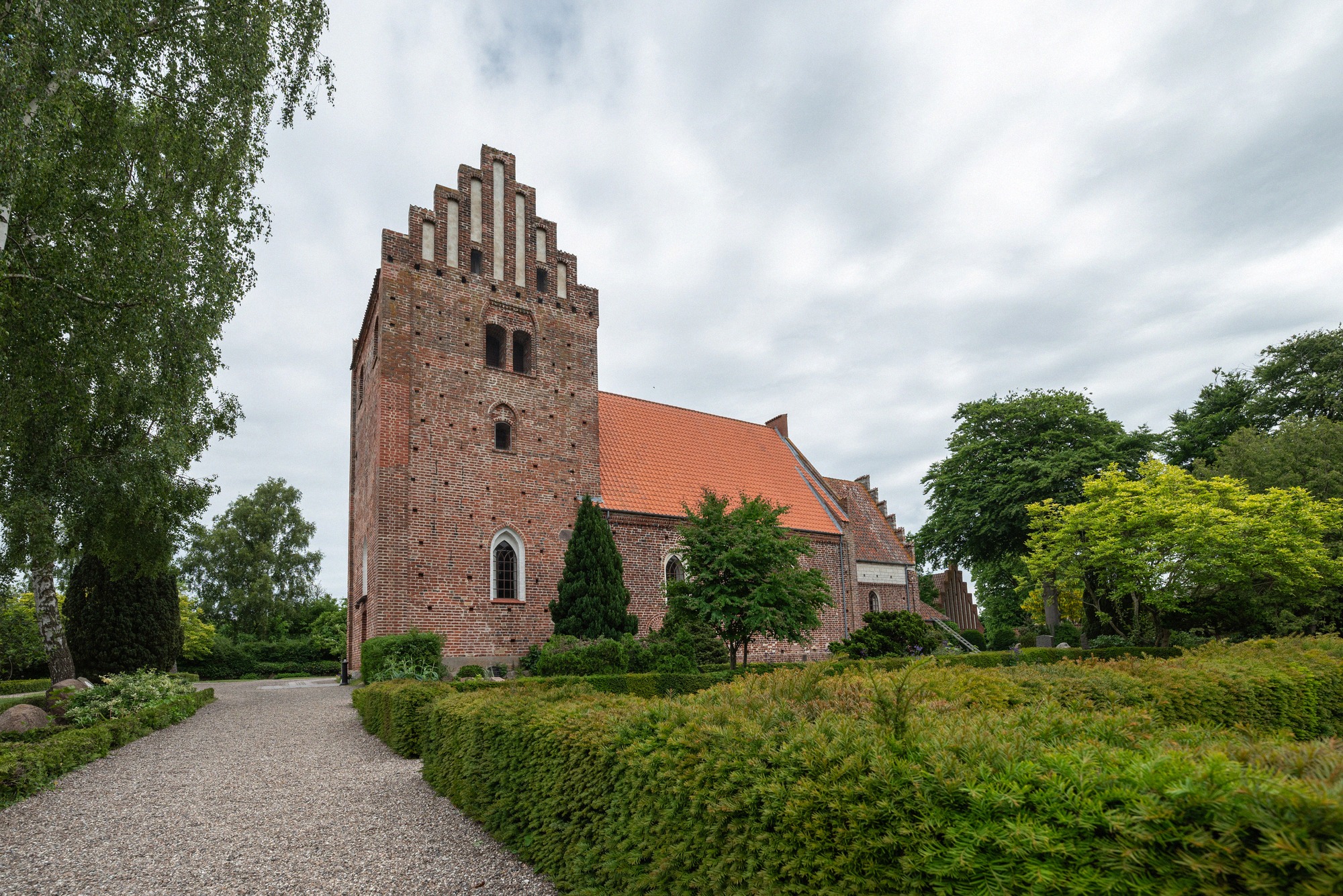
Frescoes from four eras
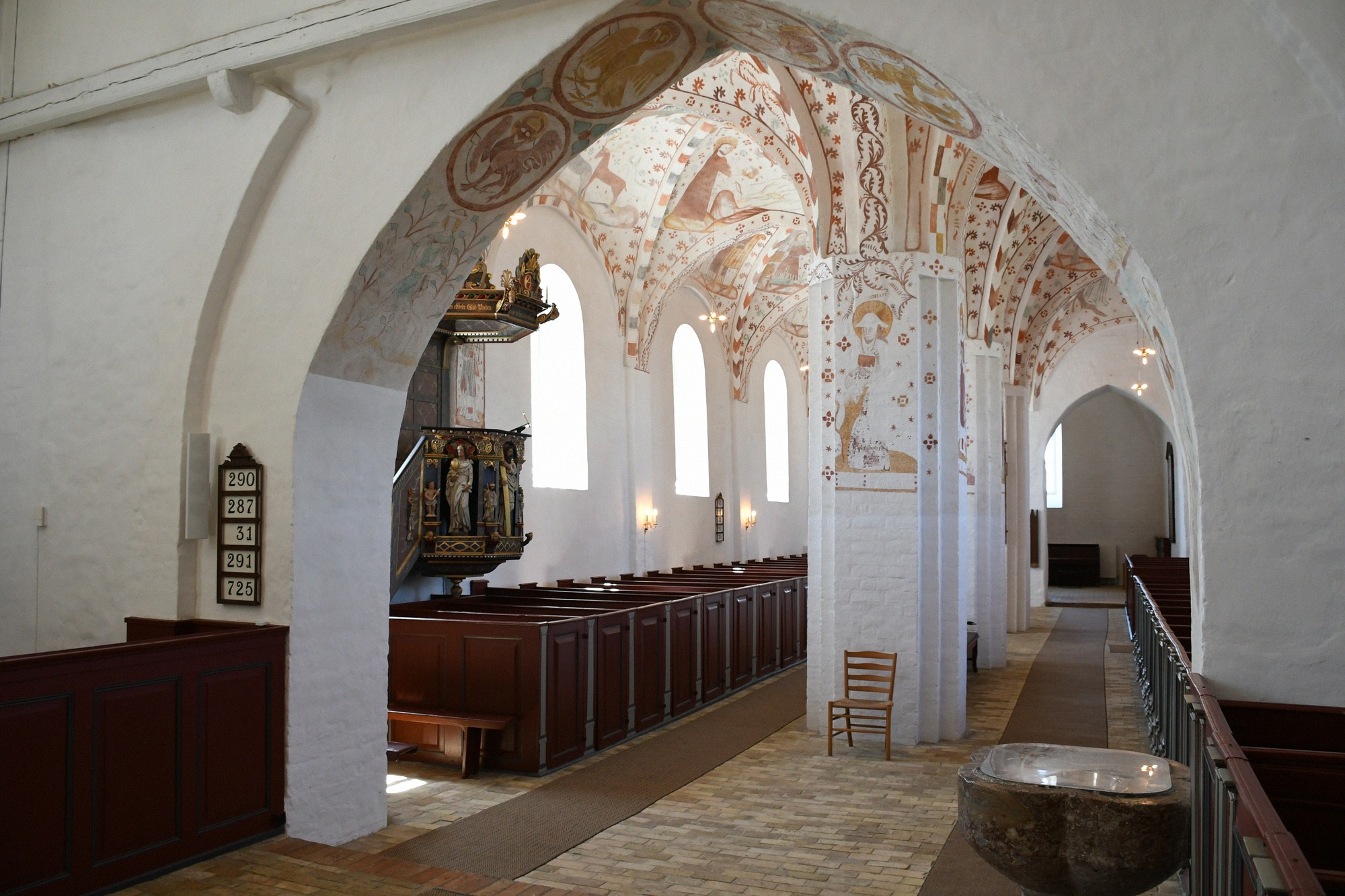
Fresco church above the fjord in western Møn
No results found.
Besides the chalk cliffs, Møn is best known for its fresco churches. In three medieval village churches - Elmelunde, Keldby and Fanefjord, the vaults are covered edge to edge with wall paintings. The most famous were created by an unnamed artist known simply, after his principal work, as the Elmelunde Master; he was active from the 1480s and painted his main works around 1500. The scenes tell stories from the Old and New Testaments, from the Creation to the Last Judgement, and served an illiterate population as a kind of picture-book Bible for the poor. Whitewashed over after the Reformation, they were only rediscovered in the late 19th and 20th centuries, and now rank among the most significant medieval wall paintings in northern Europe.
Almost nothing is known about the artist himself, not even his name. He can only be identified by his brushwork and by a recurring emblem, a Bomærke, found in all three Møn churches. His style is unmistakable:
He worked from the Biblia pauperum, printed woodcut books with sequences of biblical images, at times even copying spelling mistakes and faulty Latin straight from his sources. His workshop wasn't limited to Møn: paintings are also attributed to him and his school on Falster (Tingsted, Nørre Alslev, Aastrup) and on Lolland (Kettinge).
Elmelunde Kirke is the oldest of the three, its core dating back to the 13th century. It gave the master his name, and its vaults were painted in a single, unified scheme around 1500, the Creation, the Nativity and the Last Judgement, framed by vines and ornament.

Keldby Kirke, east of Stege, has the richest painted programme of the three: layers of frescoes from four different periods sit one above the other, a chancel painting from around 1275, a large Last Judgement from around 1325, the vault decoration by the Elmelunde Master from around 1480, and a further chancel painting from around 1600. Look closely and you can trace how colour and figure style shifted across the centuries.
Fanefjord Kirke, in the southwest of the island, is widely considered the masterpiece of the three, the most artistically unified expression of the Elmelunde Master's style. The paintings were uncovered between 1932 and 1934 and thoroughly restored in 2009, which is why the colours look especially vivid today. Right next door lies the 102-metre passage grave Grønsalen (Grønjægers Høj), freely accessible across open ground.
Keldby and Elmelunde sit right on the main road from Stege towards the chalk cliffs: Keldby around 4 km east of Stege, Elmelunde a further 3.5 km or so beyond it. Both work well as a stop on the way to Møns Klint. Fanefjord, by contrast, lies off that route in the southwest of the island and needs a separate detour (roughly 15 to 16 km from Keldby).
Møn also has other medieval churches, including in Stege, Magleby, Borre and Damsholte. But for the wall paintings, it's Elmelunde, Keldby and Fanefjord that built the island's reputation.